
As we had to stay a couple of days in Gosport waiting for a sail to arrive, we used the time to finish a couple of boat jobs. As a heads up, this is going to be a very technical post. In case that does not interest you, you can probably skip this one.
Battery Problems
The boat is fitted with a 500 Ah, 12 V, lead-acid gel battery bank, which should be plenty for us. When we bought the boat, we had a surveyor on board, who measured the battery capacity and said, our service batteries were “done”, i.e. less than 20% of their original capacity. The seller talked to a marine electrician who said that the reading can be completely wrong if there has been heavy use of the batteries the same day, which was the case on the date of the survey. He then did a not so reliable test, by first completely charging the batteries via shore power and then letting them run over 24h with all appliances running on the boat. This drained the batteries by only 30%. This was a good sign and we thought that the batteries were fine.
But when we moved onto the boat we saw a 10% drop in the battery charge over night without using any electronics, just running the fridge. And in the morning, we charged the boat from 70% to 100% in less than one hour (and that in England in September with only 350 W of solar pannels). Maybe our batteries have lost their capacity nonetheless? After a day of reading manuals and watching Youtube videos about all the bad things that can go wrong with your batteries, we figured out what the problem was. Turns out that our battery charge display was giving wrong readings. We have a very nice display, showing us many stats of the boat, like battery levels, fuel and water tank levels, barometer and so on. But this system was not properly configured, which meant the battery charge reading was only relying on the battery voltage.
Although the battery voltage is a measure of the remaining capacity, it is very unreliable. Especially, if you have a complicated system with an inverter charger, a solar charger and an alternator on the boat. What typically happens during a day on a boat, is that sometimes we charge with the sun, but then a cloud covers the solar panels and we stop charging. Then we may put on a kettle, drawing 100 A for 5 minutes. Soon after we may turn on the motor for 5 minutes to drive into a harbour, charging the battery for a short time. All these irregular periods of charging and discharging make the battery voltage go completely wild. What you need to do is measure the current and constantly add and subtract the energy or Ampere hours from your batteries’ total capacity. To measure these currents you need a shunt. A shunt is basically a very low resistor which you add after your battery. Then you can measure the voltage drop across it to figure out how much current is running through it at any point in time. You then simply add and subtract Ampere hours to and from the battery and divide this by the total capacity to give a percentage reading of the battery charge. This needs to be calibrated sometimes, typically after a full charge, as small deviations will lead to errors over time. But in the short term (days/weeks), it gives you very reliable battery percentage readings.
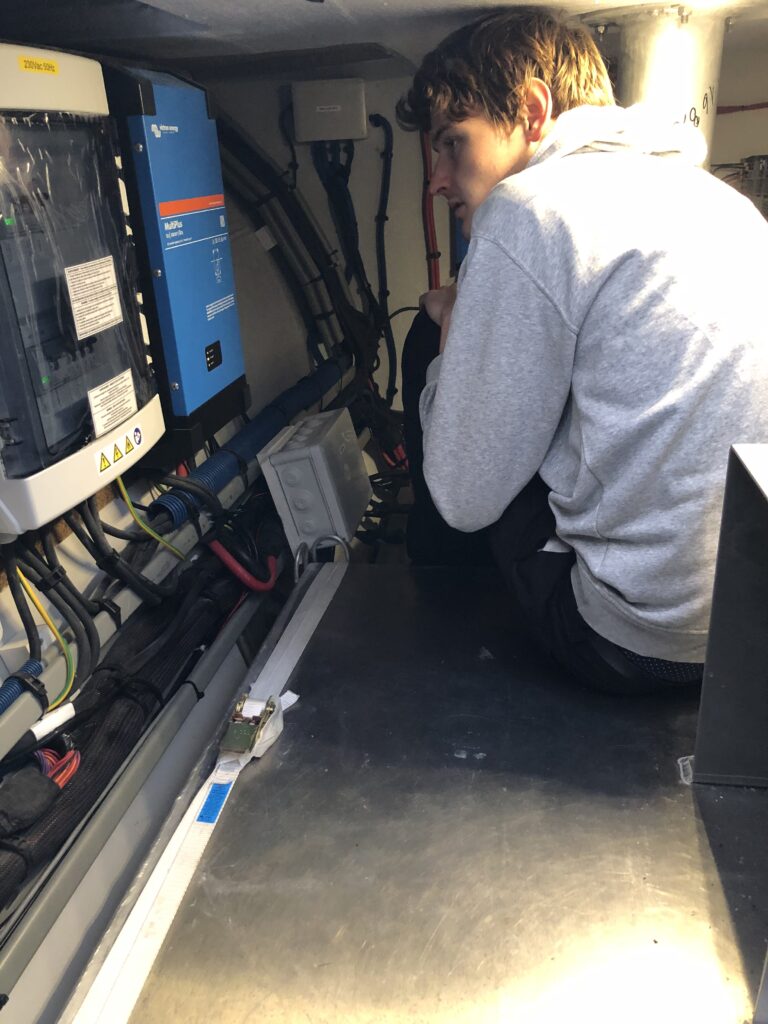
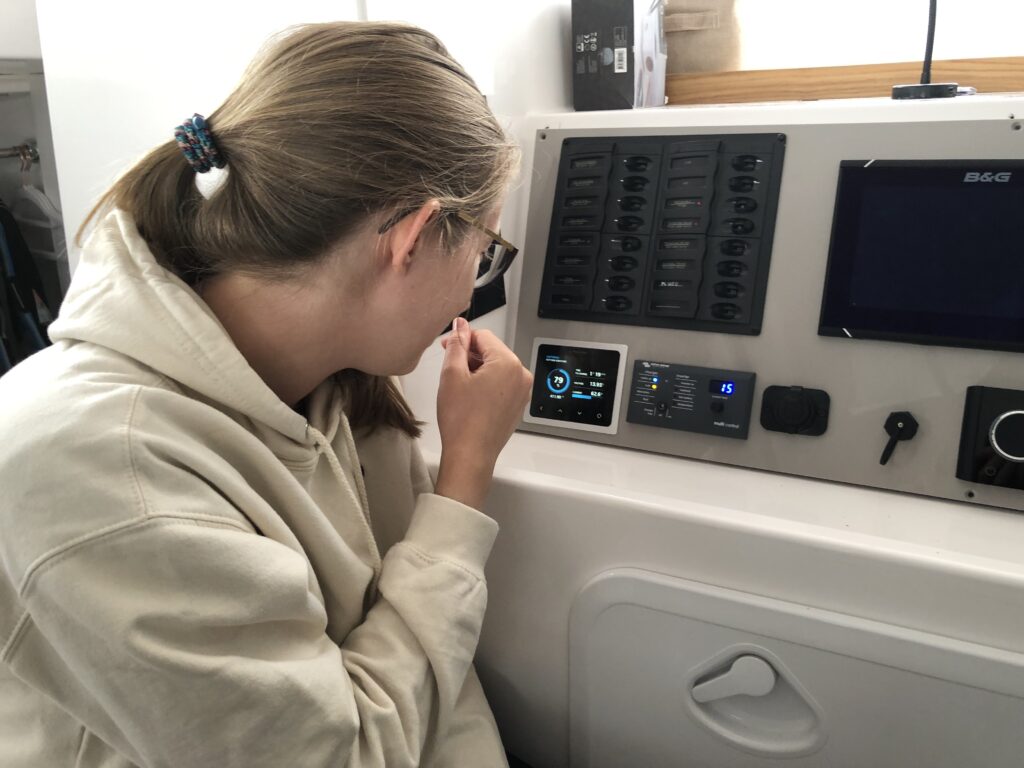
So it turned out, that the shunt wasn’t connected properly to our battery monitor, which (once we have figured it out) was a very easy problem to fix!
AIS Problems
Automatic Identification System (AIS) is a system with which you can see other vessels around you. It works via a VHF antenna (very high frequency radio). Every boat with an AIS system installed and activated will send its position and speed (as well as some other information about them, eg. vessel type, length, etc.). You then pick up this signal, and display all the boats around you on a chart plotter. This is very useful to prevent collisions between vessels, especially in bad weather with low visibility and at night. Such an AIS system is installed on our boat, but was not yet sending our position.
Every boat with a radio station (which includes an AIS transceiver), needs a radio license. This radio license includes a number, the MMSI (Mobile Maritime Safety Identification), which is basically a unique vessel identification number. Quite similar to a phone number you can also call other boats via their MMSI number. Rules and regulations prevent you from changing your MMSI, and you can only configure it once for your radio equipment. Luckily for us, our boat and AIS have not been registered yet with its previous owner, so we could set our MMSI number. So until now we only received information of all vessels around us, but were not sending our own data yet. We did not want to sail at night, because other vessels would not be able to see us.
We now simply wanted to set our MMSI number for the system, therefore connecting a PC via a mini-USB cable to the AIS transponder. This was already the first problem. Mini-USB is an outdated cable and we didn’t have one on board. Checking several shops nearby, nobody was selling it. In the end we found a Vape-shop in Gosport, where the man behind the counter went through a pile of old and broken devices until he found a mini-USB cable and very kindly gave it to us for free.
Back on the boat, we downloaded the needed software and plugged it in, but the AIS did not show up on our laptop. We tried different PCs, different software versions, turning the electronics on and off, disconnecting and reconnecting it to the device, but nothing was making the connection work. The manual was also not helpful, as it just said “Step 1: plug it in. Step 2: select your device” which was not working for us. Quite defeated we phoned up a marine electrician who kindly jumped onto our boat the same afternoon (you can usually only make an appointment about a month later), bringing his own PC, cable and software. But even he was not able to find our device. The only option seemed to be to return the device (which was luckily still under warranty) but this would have taken at least 2-4 weeks to repair. And we were very eager to finally leave Gosport as there wasn’t anything for us to do there.
The next day brought some luck. Somewhere deep inside a cruiser forum (after already searching the web for hours the day before) we finally found a thread which pointed out that you may need to unplug the NMEA cable which is used to send the AIS data from the transceiver to the chart plotter. Personally, I would have never tried this, as we already turned off the whole electronics system while only powering the AIS via the USB cable. But it turned out that this was the solution. Not even the marine electrician and the AIS expert he phoned knew about this. Unplugged, we instantly saw the device on our PC and were able to enter our MMSI and the vessel information, problem solved!
Interestingly, the AIS asked about the relative position of the GPS receiver on the boat, so we measured it out. For small boats, such as ours, this really doesn’t matter much, but if a 300 m long tanker has its GPS receiver at the front or at the back of the ship it can make a big difference.
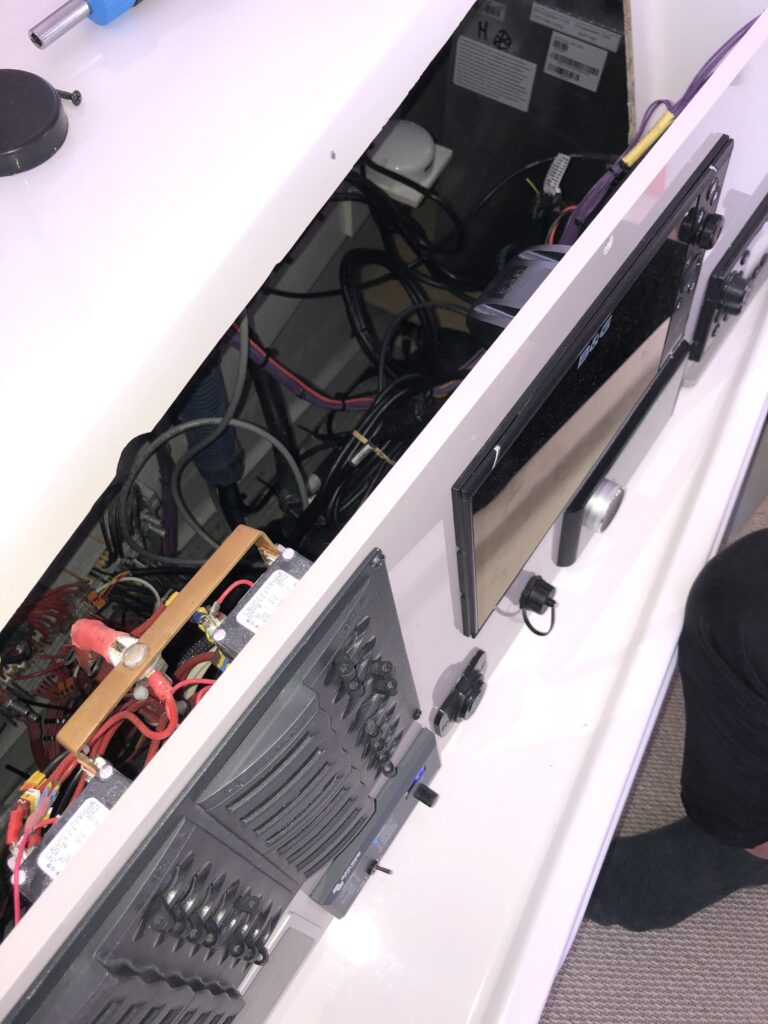
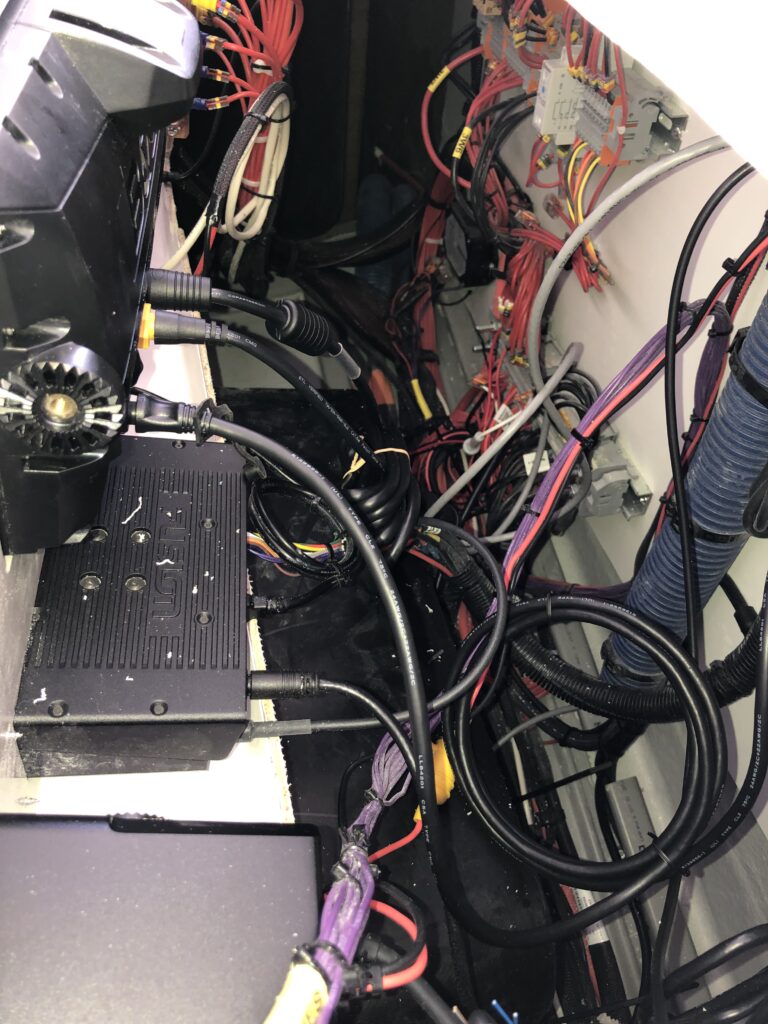
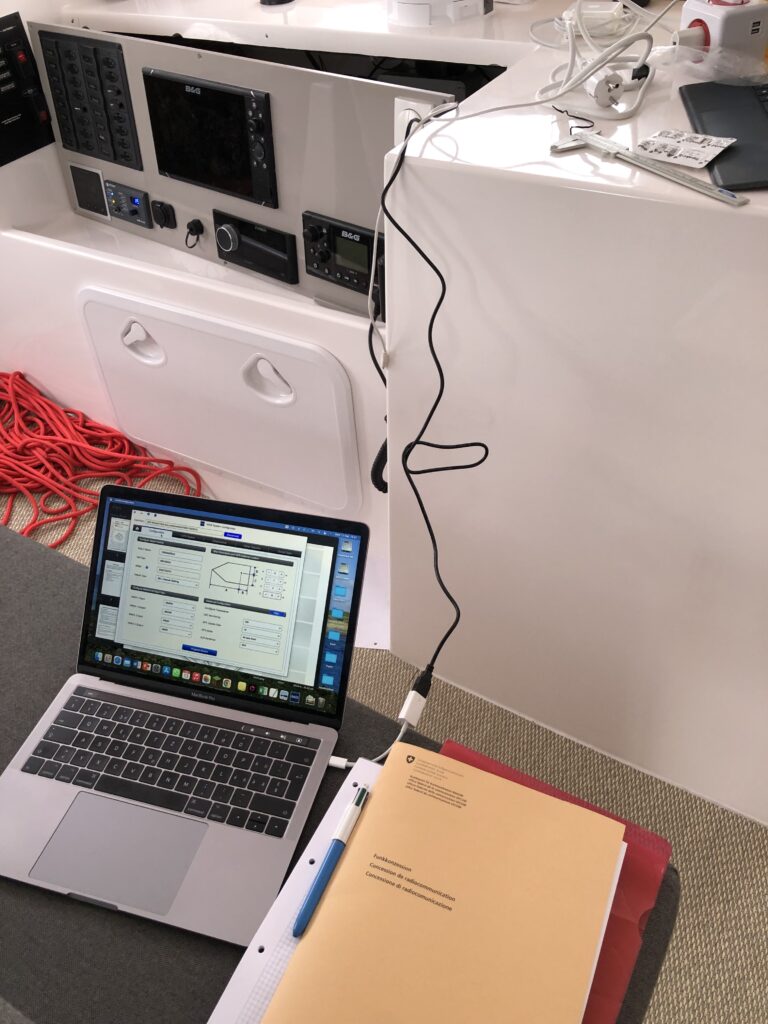
After finishing the setup, Tremoggia was finally showing up on AIS vessel finders and we were very happy again!
Uuiiiuuuiiiuiii, dass man nicht nur segeln können muss, sondern auch noch Stromfachfrau/mann und IT-Spezialist/in sein muss, wenn man so eine Fahrt übers Meer antreten will, das hätte ich mir jetzt nicht gedacht. Ist ja schon sehr anspruchsvoll. Aber Ihr seid beide spitze, auch in diesen Bereichen. Toll, habt Ihr alles zum Funktionieren gebracht!!
Problems with Solar Batteries (suggested “banging them” doesn’t help), select your device (in the Jeep, not possible) all this sounds very familiar to me, but fortunately for us, we are on land and not in a boat and if we can’t solve the problems it doesn’t really matter.
Ihr zwei seid direkt unheimlich clever, so mache ich mir keine Sorgen um Euch. Ihr werdet vergnügt weiter segeln und alle Herausforderungen meistern. Es ist so spannend, eure Berichte zu lesen und ich freue mich schon auf die folgenden. Wir sind in Heber und irgendwie fehlt ihr uns hier. Es war einfach lebendiger letztes Jahr um diese Zeit, bzw. im Oktober.
Weiter gute Reise 👋🍀❣️
Tante Katharina